American Express · 2024 · Enterprise SaaS

The receipt nightmare.
Told properly.

Corporate cardholders at a global financial services firm were waiting 20–30 days for their transaction data to arrive — and when it did, it arrived incomplete. Receipts were gone. Batches had gaps. This is what happened when we fixed it.

20–30 days minutes
Read the story
Year 2025
Role Product Designer
Platform Enterprise SaaS
Markets 20 plus
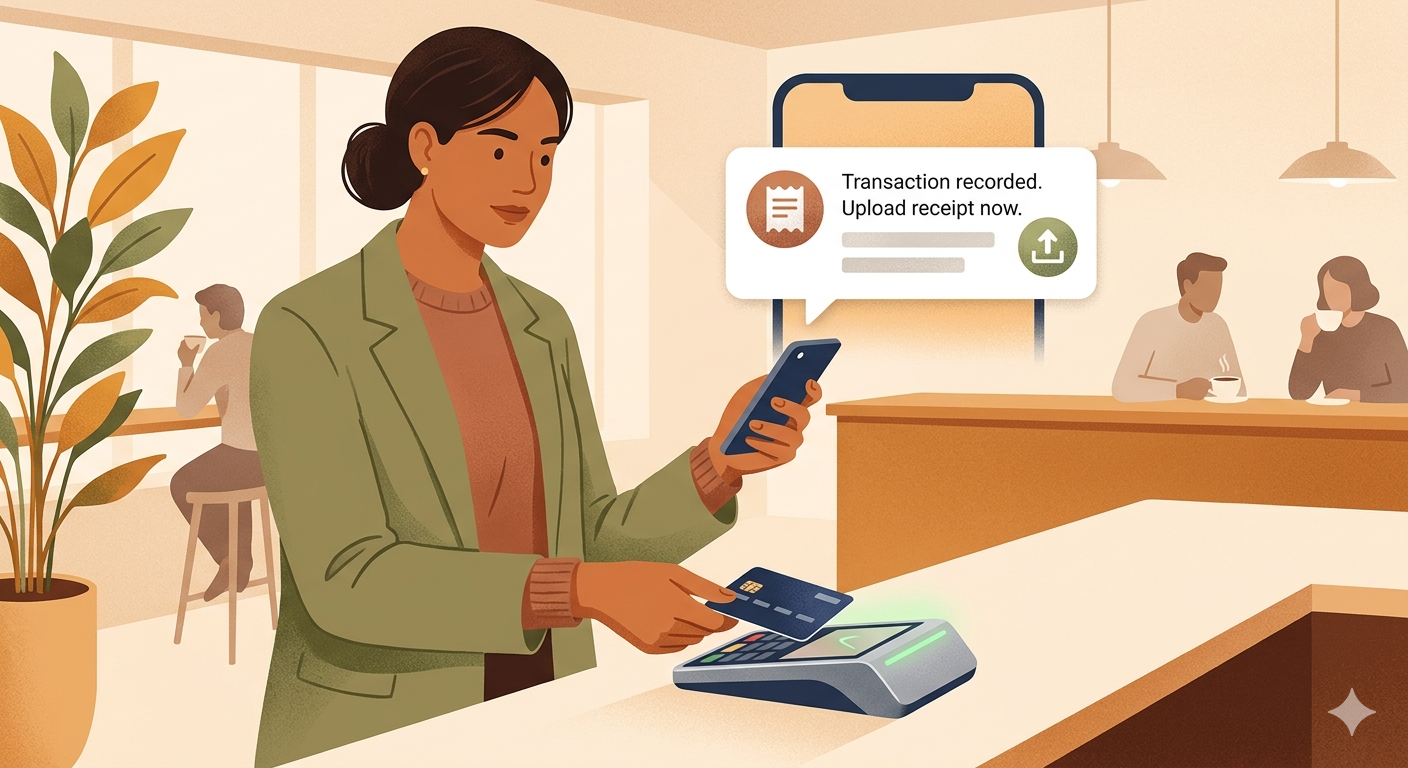
A corporate card transaction — the moment everything begins

Where it begins

"Every corporate card transaction starts the same way. A tap. A beep. A receipt."

Simple. Unremarkable. The beginning of a process nobody signed up for. What follows is four problems and the design decisions that made them unnecessary.

This project sat within the Global Commercial Services division the B2B arm of a major financial services firm managing corporate cards and expense solutions for enterprise clients worldwide. The users were employees at those client companies: consultants, managers, and frequent travellers who used corporate cards for business expenses. Their job after every trip was to reconcile those expenses match each transaction to a receipt and submit it through their employer's ERP system. Before this platform existed, there was one problem at the centre of everything: the data simply wasn't there yet.

Who are the users

Corporate cardholders at enterprise client companies employees using company cards for travel and business expenses

What were they doing

Reconciling business expenses after travel matching card transactions to receipts through their company's ERP system

What was missing

The transaction data. Batch processing meant it took 20–30 days to reach the ERP. By then, receipts were gone and memories had faded

Four problems. Four design decisions. Here is how it went.

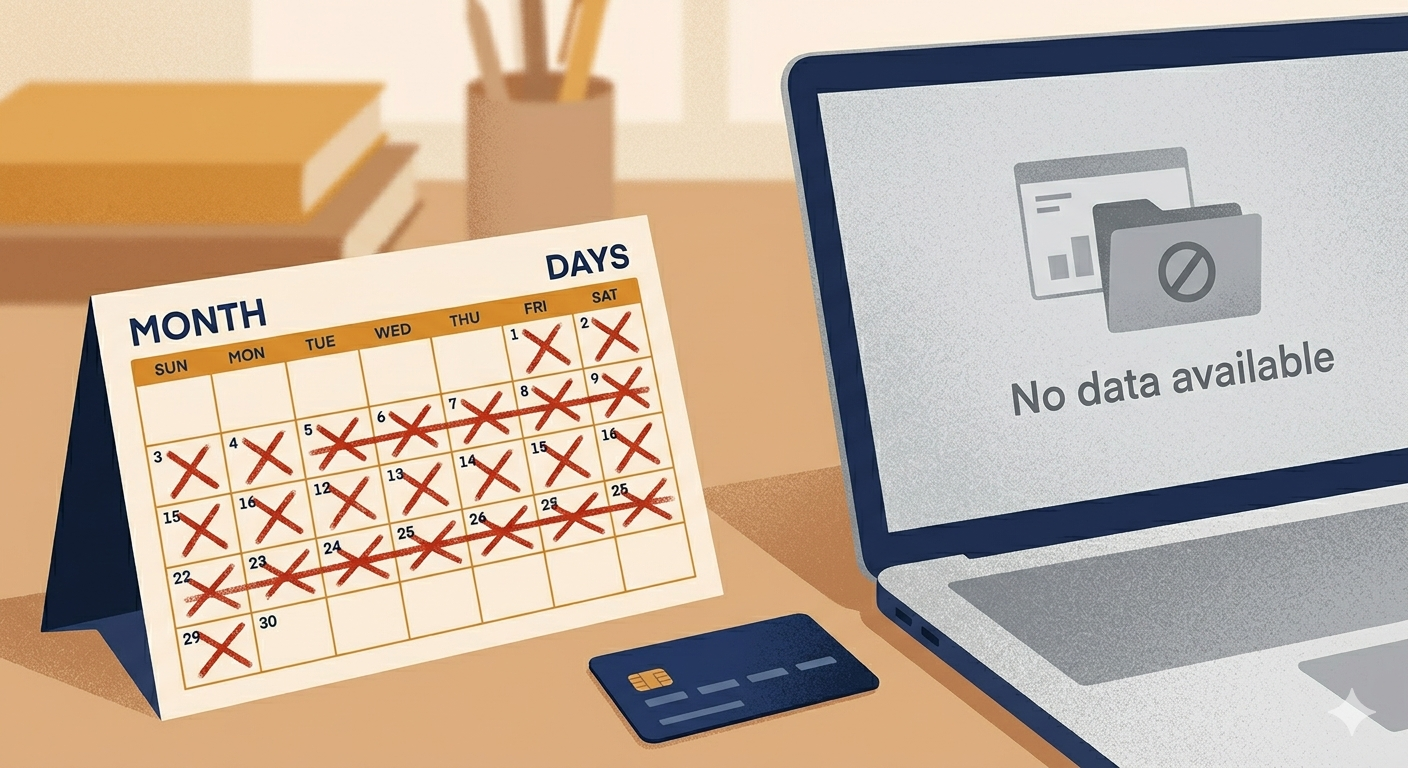
20 to 30 days of waiting — calendar marked, no data available yet
01 The first problem

The 20–30 Day Wall

"I'm back from the trip. The expenses are due. But the transaction data isn't there yet. So I wait." — Corporate cardholder, frequent traveller
Before

Batch processing. Data flows overnight, once a day.

Transaction data entered a batch queue and took 20 to 30 days to flow through to the company ERP. Cardholders could not begin filing expenses until that data arrived. There was nothing to do but wait — and hope the receipts survived the bag.

After

Real-time trigger. Data arrives in minutes.

The moment a transaction occurred, a real-time trigger fired. Data left Amex systems immediately and landed in the ERP within minutes. The window to reconcile opened before the cardholder even left the counter.

Blocked · Waiting · Nothing to do but hope the receipts survive
Immediate · Unblocked · Reconcile before you leave the counter
Two weeks of transactions in a bag — screenshots hoping they survive the camera roll
02 The second problem

The System Nobody Asked For

"I have a whole system. Photo on my phone, email to myself, paper in the bag. It's not accounting. It's survival." — Corporate cardholder, frequent traveller
Before

Every traveller invented their own shadow process.

With no reliable data flow, people bridged the gap themselves. Photographs of receipts. Email forwards. Paper stuffed into a bag. A promise to sort it out later. These workarounds were not optional — they were survival tactics for a system that had already failed them.

After

One flow. One source of truth. Nothing to cross-reference.

When data arrives in real time, the gap closes. There is no dead zone to bridge. The shadow process — built entirely to survive a broken system — has no reason to exist. Workarounds disappear when the system finally works.

Resourceful out of necessity · Anxious about the bag surviving
Freed · Trusting the system to do its job
03 The third problem

The Context Cliff

"What was this £80 charge? I closed that project two weeks ago. I genuinely cannot remember." — Corporate cardholder, returning from travel
Before

By day 20–30, context had evaporated.

Memory fades fast. Three weeks after a business trip, the context behind each expense was gone. Which meeting was that dinner? Which client was that taxi? Receipts were missing. Projects had closed. Reconciliation became a reconstruction exercise with incomplete evidence.

After

Same day. Receipt in hand. Context completely fresh.

With data available in minutes, cardholders could reconcile the same day. Receipt in hand. The meeting still on the calendar. The project still open. Every transaction filed with full context while it was still vivid — not weeks later as a forensic exercise.

Uncertain · Piecing together fragments · Hoping
Clear · Confident · Everything still fresh
This should not be a 2am task — manual matching weeks after the fact
04 The fourth problem

The Archaeology Session

"This should not be a 2am task. I'm cross-referencing bank statements, emails and a calendar from three weeks ago." — Corporate cardholder, expense filing
Before

A 10-minute task became hours of forensic work.

Every expense filing session was a reconstruction. Bank statements cross-referenced against email confirmations cross-referenced against a calendar from three weeks ago. Some receipts missing. Some wrong. All late. This was not expense management — it was archaeology on your own financial history.

After

The audit trail builds itself in real time. Nothing to reconstruct.

When data flows immediately and receipts are uploaded while the context is fresh, there is nothing to piece together later. What used to take hours of cross-referencing is done before you finish your coffee. The session that should not exist, does not.

Defeated · Overwhelmed · Late at night doing this
Done · Clean · Before you leave the coffee shop
Real-time transaction data available immediately — same action, completely different outcome

What made this possible

"None of this was visible to the cardholder. The experience they felt was simplicity. Behind it was anything but."

The real design work sat one layer deeper — on the internal tools that account managers used to configure, migrate and manage real-time data sharing for each client. Built in close collaboration with engineering, data and client teams.

The internal tools

Built for account managers.

Screens shown are representative wireframes. Actual production designs are under NDA.

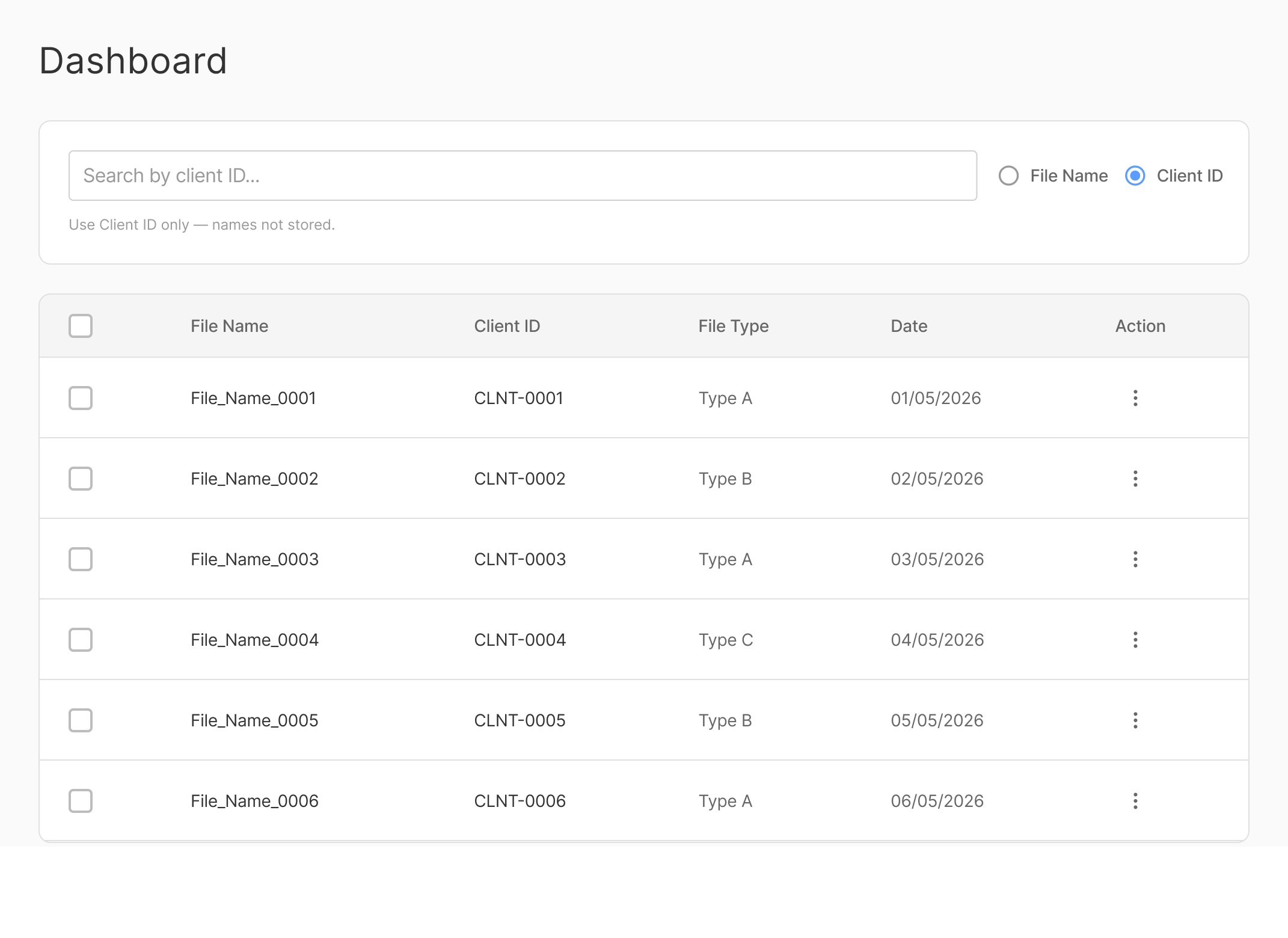
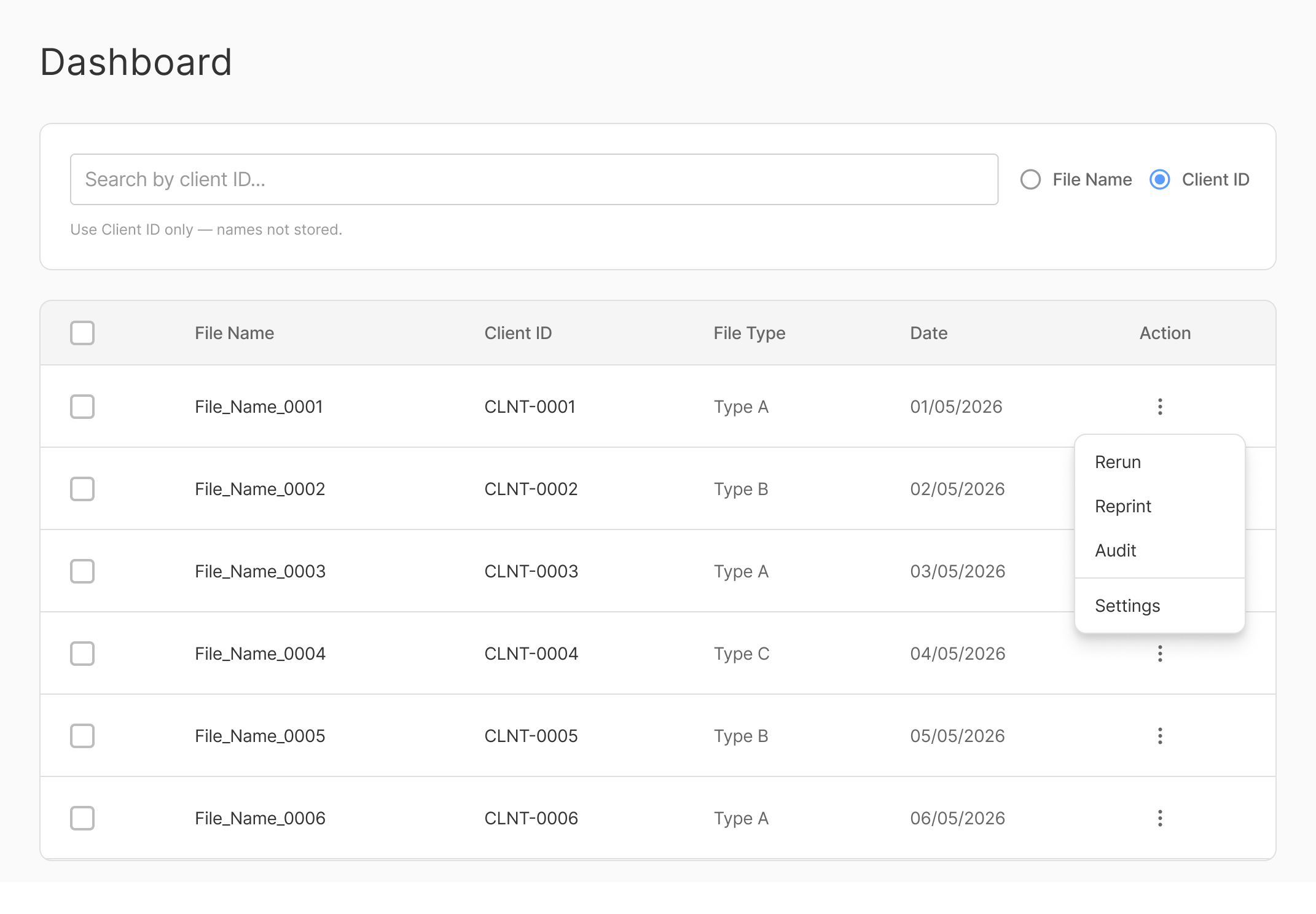
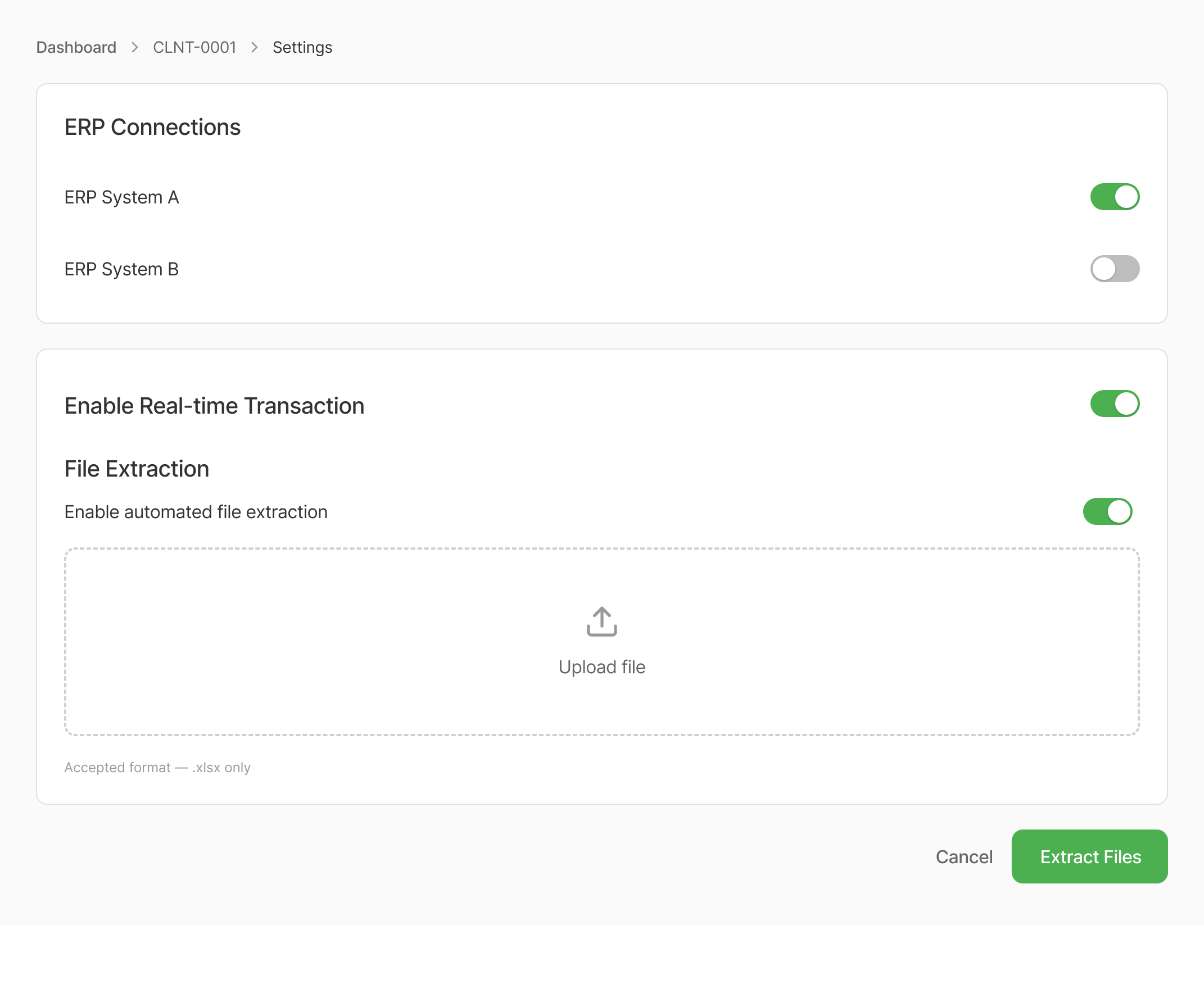
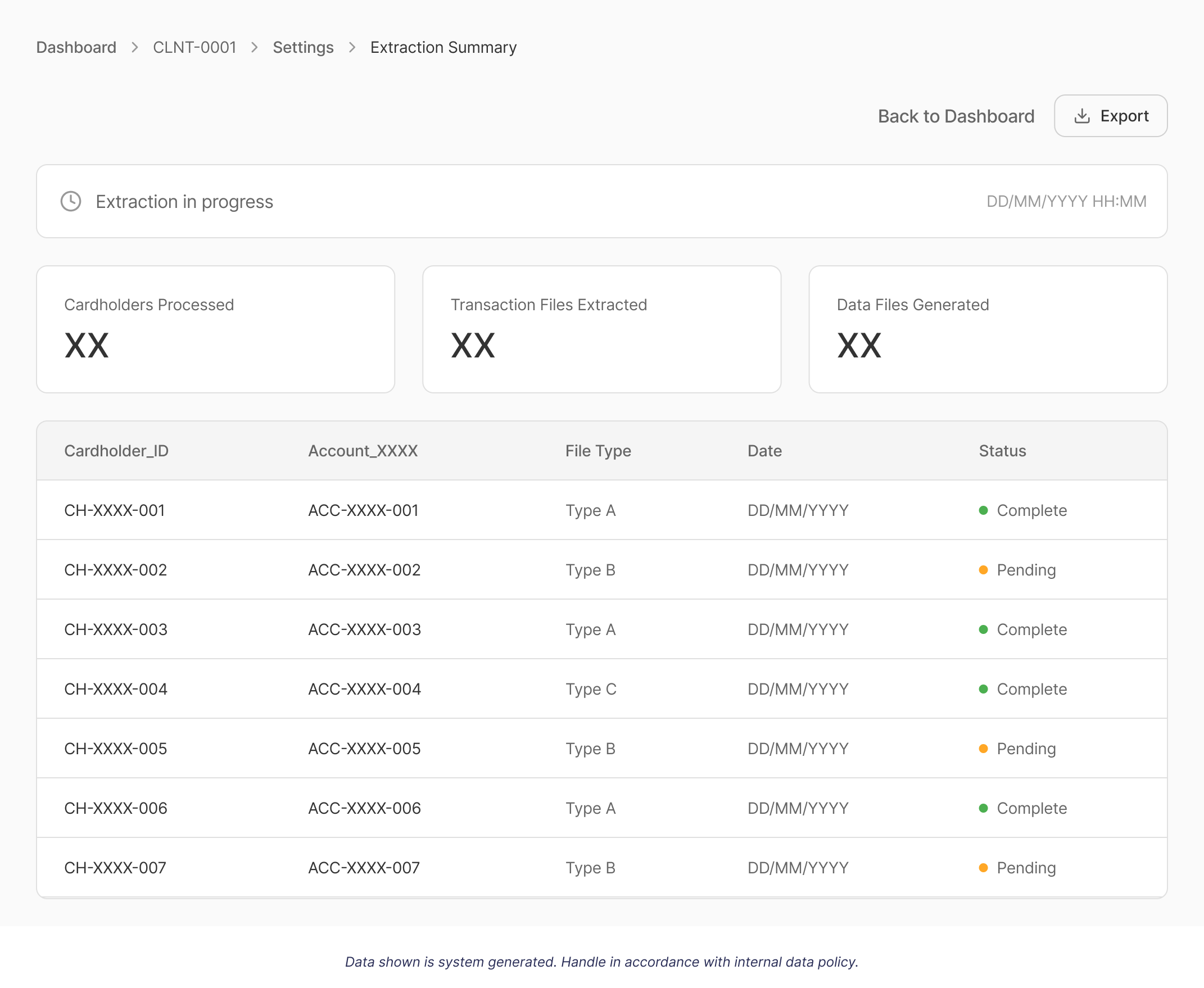
Four screens showing the internal dashboard account managers used to manage client data files and configure real-time data sharing — the infrastructure that made the cardholder experience possible.

Dashboard wireframe 1 — data files list The starting point for every account manager. A searchable list of all client data files, identifiable by ID only.

Client ID search. Names never stored, compliance by design.

Dashboard wireframe 2 — action menu expanded Four actions per file. Rerun, Reprint, Audit and Settings. Settings is the gateway to real-time configuration.

Settings is the only entry point to real-time setup, keeping the surface clean.

Dashboard wireframe 3 — settings panel ERP connections managed at the client level. Real-time enabled per connected ERP, not globally.

Per-ERP toggle prevents partial data mismatches during phased rollout.

Dashboard wireframe 4 — extraction summary Once extraction runs the account manager sees a full status view. What processed, what is pending, and a full audit trail.

Audit trail is non-editable. Accountability baked in, not bolted on.

Impact

The numbers that came back.

Minutes

Data that previously took 20 to 30 days now available in minutes

Seamless

Client testing completed with strong satisfaction on integration stability and real-time accuracy

Smooth

Existing clients transitioned without disruption to established workflows

Independent

Account managers able to manage file automation without engineering dependency

All work

Back to all work.

View all case studies